15 free questions from the CinnaEMS ems operations bank (509 in the app). Tap an answer to check it. The rationale opens right away.
An error of yours has reached the patient and they are awake and asking what just happened. You should:
Answer: A. Tell them plainly what happened and what follows
It happened to them, in their body, and they are the one person with an unarguable claim on the facts — a plain account is also what preserves any trust the rest of the call earned. Routing it only to the clinician treats the patient as the subject of the conversation rather than a party to it, and waiting for a review answers a question that has already been asked.
At a scene that will also be investigated, care of the patient and preservation of what an inquiry needs relate to each other in that:
Answer: A. Care comes first, and most preservation costs nothing
There is no real competition most of the time: walking one route, touching what you need and nothing else, and remembering what you moved are habits that cost a crew no minutes at all. Putting preservation first means a treatable patient waits on a scene, which no investigator wants, and leaving it until afterward loses the state of things at the moment you arrived.
You ask everyone who can walk to move to one area. A man stays where he is and tells you he uses a wheelchair and cannot stand. You should:
Answer: A. Sort him where he lies, on what you find
Walking is a shortcut for airway, breathing, circulation and mentation all being good enough, and it fails for anyone who could not walk this morning either. The category has to come from what you can actually assess. Counting him with the walking group would give him a category he never earned, and tagging him urgent simply because he is seated spends a resource somebody else needs.
A patient in the collection area for the least urgent group tells you he is going home and walks toward the road. You should:
Answer: A. Speak with him, and record what he decided and when
He is still a competent adult who may refuse, and the incident still has to be able to account for everybody it sorted — so the answer is a conversation and a record, not a barrier. Letting him walk unrecorded leaves a patient count that is wrong, and having him held converts a refusal into a restraint nobody has authority for.
An officer wants to question your patient about the collision while you are assessing and treating them in the back of the unit. You should:
Answer: A. Say what you can allow now and what has to wait
The investigation and the patient both have legitimate claims on the next few minutes, and the workable answer is a negotiated one — a short exchange now, the rest later. A flat refusal treats a colleague with a real job as an obstruction, and letting the questioning proceed over the top of your work means neither task is being done properly.
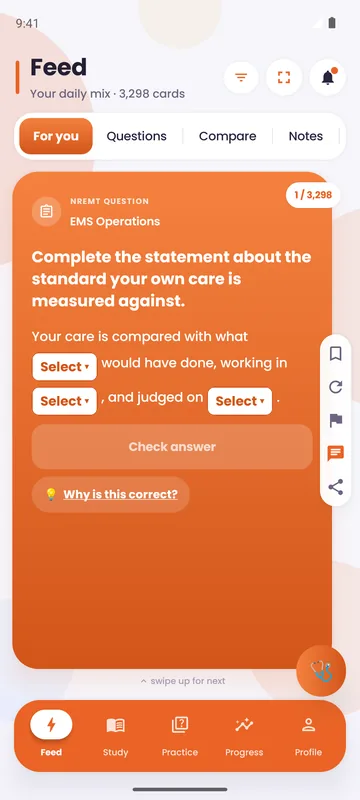
The mark or tag placed on a patient during sorting stays physically with them through the incident chiefly because it:
Answer: A. Travels to whoever sees them next, with no handover needed
At an incident nobody has time to brief anybody, so the decision has to ride on the patient and be readable at a glance by a stranger. That is the whole design. Knowing who assessed them matters eventually and matters far less right now than the fact that the next provider can read the category without finding you, and without asking the patient anything.
Driving back, you realize you gave the receiving clinician an incorrect piece of information. You should:
Answer: A. Go back and correct it with the person who took over
Care is being given right now on the basis of what you said, so the correction has to reach the person acting on it rather than a document they may read later. Calling the mistake innocent describes how it happened and changes nothing about the decisions being made from it at the bedside.
A care facility is being evacuated ahead of a rising flood. The priority for the EMS units assigned is to:
Answer: A. Match each resident's needs to the transport being used
An evacuation is a transport problem before it is a clinical one: a ventilator-dependent resident and an ambulatory one need different vehicles, equipment and escorts, and matching them is what keeps the movement safe. Emptying the nearest rooms first is quick and leaves the most fragile residents until last.
A patient contaminated by a chemical is not loaded into your compartment until decontamination is complete, principally because loading them would:
Answer: A. Contaminate the crew, the unit and everyone downstream
A closed compartment concentrates whatever came in with the patient, and the unit then carries it to a building full of people who have no protection at all — one patient becomes a department. The extra cleaning is real and is the smallest of the consequences; the reason the sequence is absolute is what happens to everybody between the scene and the end of that journey.
A service introduces a short written checklist for a high-risk procedure. Checklists help chiefly because they:
Answer: A. Catch the routine step that memory drops under stress
Memory is the first thing to fail when a provider is rushed or frightened, and a checklist protects the simple steps that get skipped precisely because they are obvious. It assumes competence rather than substituting for it, and it never moves responsibility off the person performing the task.
Workers at a factory were splashed with a chemical. The document that gives its specific hazards, first-aid measures and protective equipment is the:
Answer: A. Safety Data Sheet kept by the facility for that product
Facilities must keep a Safety Data Sheet for each hazardous chemical, and it is the most specific source for that product's hazards, first aid and protective equipment. The ERG gives general guidance for transport incidents, shipping papers identify a shipment, and the diamond gives only broad hazard ratings.
Photographing a wound on your own telephone to show the receiving clinician is a problem chiefly because:
Answer: A. The image sits outside the record on a personal device
An identifiable clinical image on a personal phone is a disclosure waiting to happen, and it lives outside every safeguard the record has. That a clinician will look again is true and secondary: the objection would stand even if the picture were clinically useful, which is why services prohibit it.
Access to the working area around a hazard is controlled by the agency managing that hazard. For an EMS crew this means you enter:
Answer: A. When they say the area is ready for you
One agency holds the picture of what the hazard is doing, and a perimeter that individual crews can talk themselves past is not a perimeter. Matching their protective clothing is the most convincing wrong answer on the list: the clothing is the smaller half of their preparation, and wearing it without their training or their plan buys confidence rather than safety.
During a busy call your partner says, "Give the dextrose now." What is the safest way to respond before you administer it?
Answer: A. Repeat the drug, route and amount back and wait for confirmation
Closed-loop communication means the receiver repeats the order and the sender confirms it before action, which catches a misheard drug or amount while it can still be corrected. Announcing it afterward only documents an error that has already happened, and a written order mid-resuscitation delays care without adding the verbal cross-check that prevents the mistake.
A patient with a valid advance directive declining resuscitation arrests, and a relative demands that you start CPR. You should:
Answer: A. Follow the directive and involve medical direction if conflict continues
The directive records the patient's own wishes, which outrank a relative's wishes when the patient cannot speak. Medical direction exists for exactly this standoff. A relative's signature cannot transfer responsibility for overriding a valid directive, and a pretended resuscitation is a lie.
Answer all 15 questions to see how you did.
Free to start
Timed mock exams, a rationale on every answer and progress that follows you from web to phone.
