OPA for an absent gag; NPA when the gag is intact.
Before you read
Test yourself first: 5 questions
Question 1 of 5
An unresponsive adult has snoring respirations at 8 per minute. Your FIRST action is to:
Answer: A. Snoring is the tongue obstructing the hypopharynx, and a manual maneuver corrects it immediately with no equipment. Adjuncts and ventilation are useless through an airway that is still closed, which is why opening it comes first rather than reaching for the bag.
Question 2 of 5
You are inserting an oropharyngeal airway in an unresponsive 3-year-old. The preferred technique is to:
Answer: A. In a child the soft palate and oral tissues tear easily, so the airway is placed right side up with a tongue blade holding the tongue down, following the natural curve of the mouth. The upside-down-and-rotate method used in adults can injure the palate and cause bleeding into a small airway. The nose-to-earlobe measurement sizes a nasal airway; an oral airway is sized from the corner of the mouth to the angle of the jaw or the earlobe.
Question 3 of 5
As you insert an oropharyngeal airway in a patient who responded only to pain, he begins to gag and retch. You should:
Answer: A. A gag reflex means the patient will not tolerate an oral airway and may vomit and aspirate if it stays in. A nasopharyngeal airway is usually tolerated by a patient with a gag reflex who still needs help keeping the tongue off the airway. Forcing or securing the oral airway turns a protective reflex into vomiting in a patient who cannot fully protect himself.
Question 4 of 5
An unresponsive man struck in the head has bruising around both eyes, clear fluid from his nose and snoring respirations. He gags when you try an oral airway. The best way to keep his airway open is:
Answer: A. Raccoon eyes and fluid from the nose suggest a basilar skull fracture, so a nasal airway is avoided; the gag rules out an oral airway. That leaves manual positioning, and with a mechanism for spinal injury that means a jaw thrust rather than a head tilt, with suction and a bag-valve mask ready because this airway still needs constant attention.
Question 5 of 5
An unresponsive motorcyclist has noisy, obstructed breathing. Your partner's jaw thrust does not open the airway despite repositioning. The next step is to:
Answer: A. An open airway outranks spinal motion restriction. When a jaw thrust fails in a trauma patient, the head-tilt, chin-lift is used because a patient cannot survive an obstructed airway, while the spine can still be protected afterward. Persisting with a failed maneuver or stopping to apply a collar leaves the patient obstructed, and you never move past A until the airway is open.
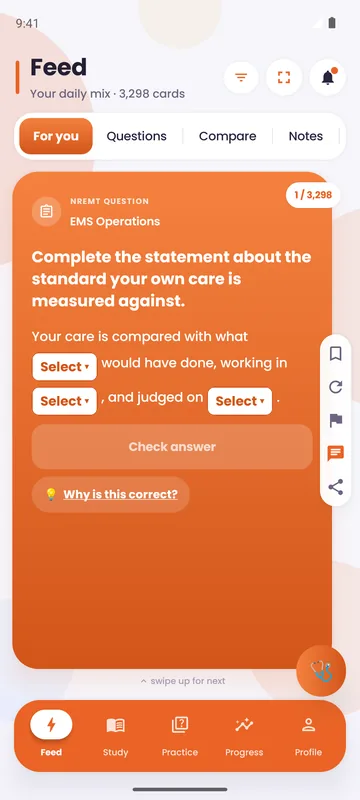
Keep the streak going with more questions like these, each with a full rationale.
Key points to remember
- OPA for an absent gag; NPA when the gag is intact.
- Neither nasally when basilar skull fracture is suspected.
- Size the OPA mouth corner to earlobe — too long occludes with the epiglottis.
- Suction on withdrawal only, ten seconds or less, then re-oxygenate.
Field priorities
- Open the airway manually first — an adjunct holds a position, it does not create one.
- Re-oxygenate between suction passes rather than extending one.
Coaching the patient
- The NPA's whole advantage is that it is tolerated with a gag.
Red flags: act now
- Retching after OPA placement — remove it
- Soot, hoarseness or singed hair after a burn
Airway Adjuncts: FAQs
What are the priority actions for Airway Adjuncts in the field?
Open the airway manually first — an adjunct holds a position, it does not create one. Re-oxygenate between suction passes rather than extending one.
What findings in Airway Adjuncts change your plan or your transport decision?
Retching after OPA placement — remove it. Soot, hoarseness or singed hair after a burn.
What do I need to know about Airway Adjuncts for the NREMT?
OPA for an absent gag; NPA when the gag is intact. Neither nasally when basilar skull fracture is suspected. Size the OPA mouth corner to earlobe — too long occludes with the epiglottis. Suction on withdrawal only, ten seconds or less, then re-oxygenate.
What should the crew communicate or document for Airway Adjuncts?
The NPA's whole advantage is that it is tolerated with a gag.