Scene safety covers you, your crew, the patient and bystanders — in that order.
Before you read
Test yourself first: 5 questions
Question 1 of 5
You have been on scene ten minutes when the patient's son arrives, shouts at your partner and steps between the two of you and the door. The correct response is to:
Answer: A. Scene safety is reassessed for the whole call, and a scene that turns hostile between you and your exit is no longer safe however far the assessment has progressed. Staying to finish, negotiating, or splitting the crew each leave a provider cut off from the door.
Question 2 of 5
A fire officer tells you the scene is clear and you can work at the front of a building that is still smoking. What 'clear' means here is:
Answer: A. Another agency's release of a scene is specific: a place, a task and a moment, given by somebody who knows what his crews are still doing inside. Treating it as a blanket all-clear is how a crew wanders into a structure that is still burning in the void spaces. The scene is reassessed continuously, and anything beyond the work you were cleared for is asked about again.
Question 3 of 5
Rain has been falling on your roadway scene for twenty minutes, and the painted lines and your loading ramp are now slick underfoot. What this changes is:
Answer: A. Wet paint and a wet metal ramp are two of the most reliable places to fall on any scene, and a fall while carrying takes down the provider and the patient together — so the answer is in how the crew moves, not in how fast it finishes. Time on scene, device placement and who drives are all real decisions, but none of them touches the footing under the carry.
Question 4 of 5
Your crew has been on a complicated scene for forty minutes, and everyone present is working on the patient. What is missing is:
Answer: A. Long scenes fail because every pair of eyes ends up pointed at the patient, and the change that hurts a crew arrives from outside that circle — so one person keeps looking up, at the people, the traffic and the exits. A spare ambulance is a resource decision, and crew vitals and a visitor log are records that nobody is reading while the scene is changing.
Question 5 of 5
What is the first decision of every scene size-up?
Answer: A. Everything else assumes you survive the approach, so safety is judged before commitment. Resource counts and the medical-versus-trauma question both need information you can only gather once you are on the scene, and destination decisions belong at the end of the call, not the start.
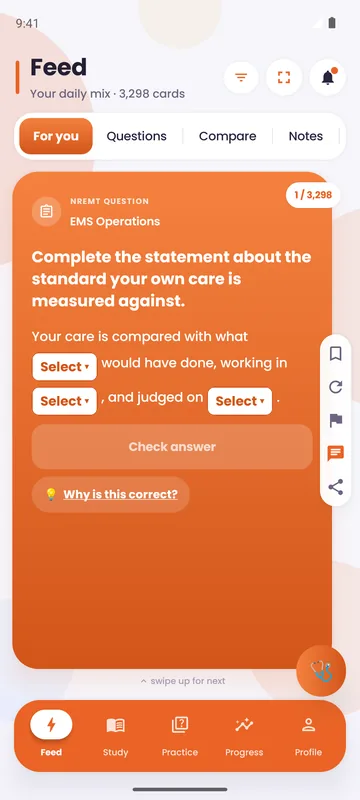
Keep the streak going with more questions like these, each with a full rationale.
Key points to remember
- Scene safety covers you, your crew, the patient and bystanders — in that order.
- Precautions follow the anticipated exposure route, not the diagnosis.
- Patient count and entrapment drive the resource request before patient contact.
- Mechanism shapes whether the exam is rapid full-body or focused.
Field priorities
- Establish command before treating when patients outnumber the crew.
- Reassess safety continuously — scenes deteriorate after arrival.
Coaching the patient
- Moving a downed wire is never an EMS task, whatever it is moved with.
Red flags: act now
- Downed wires
- Unsecured traffic
- Weapons or an unaccounted-for assailant
- Confined space or an unknown atmosphere
Scene Size-Up: FAQs
What are the priority actions for Scene Size-Up in the field?
Establish command before treating when patients outnumber the crew. Reassess safety continuously — scenes deteriorate after arrival.
What findings in Scene Size-Up change your plan or your transport decision?
Downed wires. Unsecured traffic. Weapons or an unaccounted-for assailant. Confined space or an unknown atmosphere.
What do I need to know about Scene Size-Up for the NREMT?
Scene safety covers you, your crew, the patient and bystanders — in that order. Precautions follow the anticipated exposure route, not the diagnosis. Patient count and entrapment drive the resource request before patient contact. Mechanism shapes whether the exam is rapid full-body or focused.
What should the crew communicate or document for Scene Size-Up?
Moving a downed wire is never an EMS task, whatever it is moved with.