
On this page
The steps at a glance
Registration has more moving parts than people expect, because your course has to vouch for you before you can book. Here is the order, using the National Registry's EMT candidate handbook.
- 1. Log in or create your account at nremt.org
- 2. Start an EMT certification application
- 3. Your education program verifies your course completion
- 4. Pay the $104 application fee (charged per attempt)
- 5. Receive your ATT, valid for up to 90 days
- 6. Schedule with Pearson from your Candidate Dashboard
- 7. Test, then see results in your account
Application review: why you might wait
After you submit, both the National Registry and your education program review the application for completeness and verify your education. If something doesn't match, it goes to manual review, and you are notified on your Candidate Dashboard or by email.
The most common hold-up is the program step. Ask your instructor when they plan to verify course completions so you aren't checking your dashboard every hour.
Check yourself
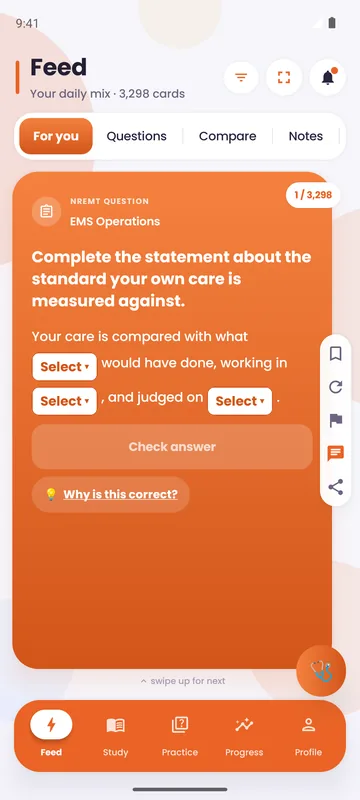
4 quick questions on this topic
Question 1 of 4
A patient in a crash is intoxicated and has an obviously fractured femur, but denies neck pain. Regarding spinal motion restriction, you should:
Answer: A. Selective spinal motion restriction depends on a patient who can be examined, and intoxication plus a painful distracting injury both destroy the reliability of a denial of neck pain. Waiting for sobriety is not an option in the field, and vehicle damage is a mechanism clue rather than a substitute for an assessment you cannot perform.
Question 2 of 4
A swimmer is pulled unresponsive from a lake after several minutes underwater. The first priority is to:
Answer: A. Submersion arrest is driven by hypoxia rather than by a primary cardiac event, so oxygen and ventilation come first and are what change the outcome. Routine spinal restriction is reserved for a mechanism that suggests it such as a dive, abdominal thrusts only bring up stomach contents to be aspirated, and drying the patient follows once breathing is supported.
Question 3 of 4
First responders hand over a patient reporting that the airway is clear and the breathing is fine. The patient is making no sound and the chest is not moving. You should:
Answer: A. A handover describes the patient at the moment it was gathered, and what you see now overrides it, so the primary assessment is repeated by the arriving provider. Accepting a report that contradicts a motionless chest trades a finding you can verify for one you cannot.
Question 4 of 4
A patient was shot through the side of the neck. He is alert with no neurologic deficit. Which approach to spinal motion restriction is most appropriate?
Answer: A. Isolated penetrating trauma without a neurologic deficit rarely causes an unstable spine, and collars can hide an expanding hematoma, tracheal shift or bleeding while delaying airway care. The joint ACS/ACEP/NAEMSP position supports withholding routine restriction here. Boarding first is the tempting reflex but has been associated with worse outcomes in penetrating trauma.
Keep the streak going with more questions like these, each with a full rationale.
The $104 fee and refunds
The EMT application fee is $104 per examination attempt. If you applied in error or no longer want certification, a refund is available within 90 days of payment, minus an administrative fee.
There is also a timing trap. Your ATT is valid for up to 90 days, but if you buy it within 90 days of your course expiration date, it expires on the course expiration date. An expired ATT means a new application and a new fee, so don't buy one until you can test soon.
Booking your appointment with Pearson
Once your ATT is issued, schedule directly from your National Registry Candidate Dashboard; you are passed to Pearson to choose a date, time and test center. You pick from the appointments Pearson shows as open, any time within your ATT window, and you'll receive a confirmation email describing what to expect at the test center.
Make sure the name on your ATT matches your unexpired, government-issued ID exactly. If it doesn't, fix it before test day.
Rescheduling, cancelling and no-shows
Changes must be made at least one business day (24 hours) before your scheduled exam. The handbook lists a $30 fee to reschedule or cancel, and Pearson charges an extra call center fee if you do it by phone, so use the website when you can.
If you miss the appointment, you forfeit your exam fee. Inside the 24-hour window, contact Pearson directly for help.
Test day and results
Leave phones, smartwatches, tablets, personal calculators, conversion tables and dictionaries out of the testing room; the National Registry prohibits them. You can be dismissed for rule violations, and fees are not refunded if you are.
Results are posted to your National Registry account, generally within two business days. The Registry doesn't email or call with results. If nothing has posted after five business days, contact the National Registry.
If you need to retest
You must wait 15 days from your last exam before testing again, and each attempt is a new $104 application. Before a fourth cognitive attempt, the National Registry requires remedial education, and that does not extend your course completion date.
Passing the cognitive exam isn't the last step. You also need state-approved BLS skills competency, which is valid for 24 months. If you pass the written exam while skills are pending, your status shows Certification Pending Requirement.
Use the waiting time
The gap between applying and testing is ideal for focused practice. The 2025 EMT exam is weighted toward primary assessment (39–43 percent of items), so put your first study hours there.
The CinnaEMS bank has 4,646 questions, including 731 on primary assessment and 567 on patient treatment and transport. The quiz on this page pulls from both.
Frequently asked questions
How much is the NREMT EMT exam?
$104 per examination attempt, paid when you apply in your National Registry account.
How do I reschedule the NREMT exam?
Reschedule at least one business day (24 hours) before your appointment. The handbook lists a $30 fee, plus a call center fee if you do it by phone.
Is the NREMT exam online or in person?
You apply and schedule online, then take the cognitive exam on a computer at a Pearson test center booked through your Candidate Dashboard.
How often are NREMT exams held?
There are no set exam days to wait for. Once your ATT posts, you choose from open Pearson appointments any time within your 90-day window.
How long does it take to get NREMT results?
Results usually post to your National Registry account within two business days. Contact the Registry if nothing appears after five.
Keep studying
Sources
Checked against official sources