
On this page
The short answer
National Registry certification and a state EMS license are two different credentials, and many working EMTs hold both. The certification is national: the National Registry grants it after you complete an approved course and pass its exams. The license comes from your State EMS Office and is what legally allows you to care for patients in that state.
The Registry says it plainly in its EMT candidate handbook: successfully obtaining National Registry certification does not grant you the right to practice. Think of the certification as proof you met the national standard, and the license as the state's permission to work.
Certification vs. license: the legal difference
The National Registry draws the line this way. Certification is recognition that a non-governmental organization grants to an individual who meets its requirements, and Registry certification is voluntary. Licensure is the state's grant of legal authority to practice, based on the state's police powers, issued by a State EMS Office or similar agency.
Terminology muddies this. Many states call their licensing process 'certification' and write National Registry standards into state law, sometimes requiring Registry certification before anyone can practice. The Registry's view is that the label doesn't change anything: if a state 'certification' is what authorizes you to practice, it has the legal effect of a license.
Check yourself
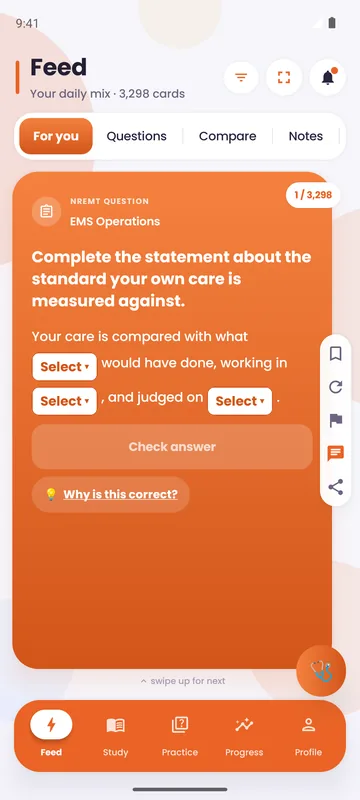
4 quick questions on this topic
Question 1 of 4
Which statement best describes an AEMT's legal duty to act within scope of practice?
Answer: A. Scope of practice is defined by certification and licensure and narrowed by local medical direction; it is never widened by a verbal order, by the stakes of the call or by what equipment is available. Performing a skill beyond scope, even competently, can be practicing without a license — the trained-but-uncertified provider is a common exam trap.
Question 2 of 4
The National Registry's role in the certification of EMS providers is to:
Answer: A. The Registry builds and administers examinations so that competence is measured the same way everywhere, which is what makes the credential portable between states. It does not authorize practice or write clinical direction; those belong to the licensing authority and medical director.
Question 3 of 4
The difference between scope of practice and standard of care is that scope of practice:
Answer: A. Scope of practice is the list of skills your certification and medical director authorize; standard of care is how a reasonable provider of that level would perform them. Confusing the two is how a provider talks themselves into a skill they are not credentialed for because it seemed reasonable.
Question 4 of 4
What is the difference between a standing order and online medical direction?
Answer: A. Standing orders are written protocols a medical director authorizes in advance, letting the provider act without contacting a physician. Online medical direction is real-time consultation by radio or phone. Neither expands the provider's certified scope of practice, so competence alone never authorizes a skill, and a standing order by definition needs no call.
Keep the streak going with more questions like these, each with a full rationale.
What NREMT stands for, and the four levels
NREMT stands for the National Registry of Emergency Medical Technicians. It certifies four levels of EMS clinician: Emergency Medical Responder (EMR), Emergency Medical Technician (EMT), Advanced EMT (AEMT) and Paramedic. You may still hear older shorthand such as 'NREMT-B' or 'NREMT-P', left over from when the levels were called EMT-Basic and EMT-Paramedic.
People also say 'I'm NREMT' to mean they hold Registry certification at the EMT level. So are NREMT and EMT the same thing? No: EMT is the clinical level, and NREMT is the organization that certifies it.
Your registry number and how verification works
The Registry's public credential lookup lets anyone search by registry number, EMS ID or name. Results show your name, certification level, EMS ID, registry number and expiration date. When people ask for your 'NREMT number', this registry number is usually what they mean.
That lookup shows National Registry certification status only. The Registry says that to verify someone's license to practice, you must contact the State EMS Office, and it notes that a person can hold a valid state license while their Registry certification is lapsed or inactive.
Moving to another state
This is where National Registry certification earns its keep. According to the Registry, all 50 states recognize its certification, but reciprocity policies vary by state, and certification does not automatically grant a state license. Before you move, contact the new state's EMS office for its reciprocity steps, fees and any state-specific requirements.
If you already hold a state license but never earned Registry certification, the Registry offers a state-licensed pathway. There's also a re-entry pathway if your Registry certification or state license has lapsed.
Keeping both credentials current
The two credentials renew separately. National Registry EMT certification runs on a two-year cycle with a March 31 expiration. You recertify with 40 credits of continuing education, split into national, local or state, and individual components, or by passing a recertification exam during the year before your expiration.
Your state license has its own renewal schedule and requirements. Put both dates in your calendar. Letting Registry certification lapse can complicate a future move to another state, even while your current license is valid.
What this means for your exam prep
In states that use the National Registry for licensing, the path for new candidates looks like this: finish a state-approved course, pass a state-approved skills competency, pass the National Registry cognitive exam, then apply to your State EMS Office. The cognitive exam is where most of your study time goes.
Legal topics such as consent, scope of practice, documentation and abandonment are part of every EMT course and turn up in practice exams. Of the 4,646 questions in the CinnaEMS bank, 509 are operations questions, and the quiz on this page starts with scope of practice, consent and medical direction.
Frequently asked questions
Is NREMT the same as an EMT license?
No. NREMT certification shows you met the National Registry's national standard. A license to practice comes only from your State EMS Office, even in states that call their license a 'certification.'
What does NREMT stand for?
The National Registry of Emergency Medical Technicians, a private, non-profit organization that certifies EMRs, EMTs, AEMTs and paramedics.
Do all states accept NREMT certification?
The National Registry says all 50 states recognize its certification, but reciprocity policies vary by state and certification does not automatically grant a state license.
What is my NREMT number?
It's your National Registry registry number. It appears in the Registry's public credential lookup alongside your name, level, EMS ID and expiration date.
How long does NREMT certification last?
Two years for EMTs, with a March 31 expiration. You recertify with 40 continuing education credits or a recertification exam.
Keep studying
Sources
Checked against official sources