
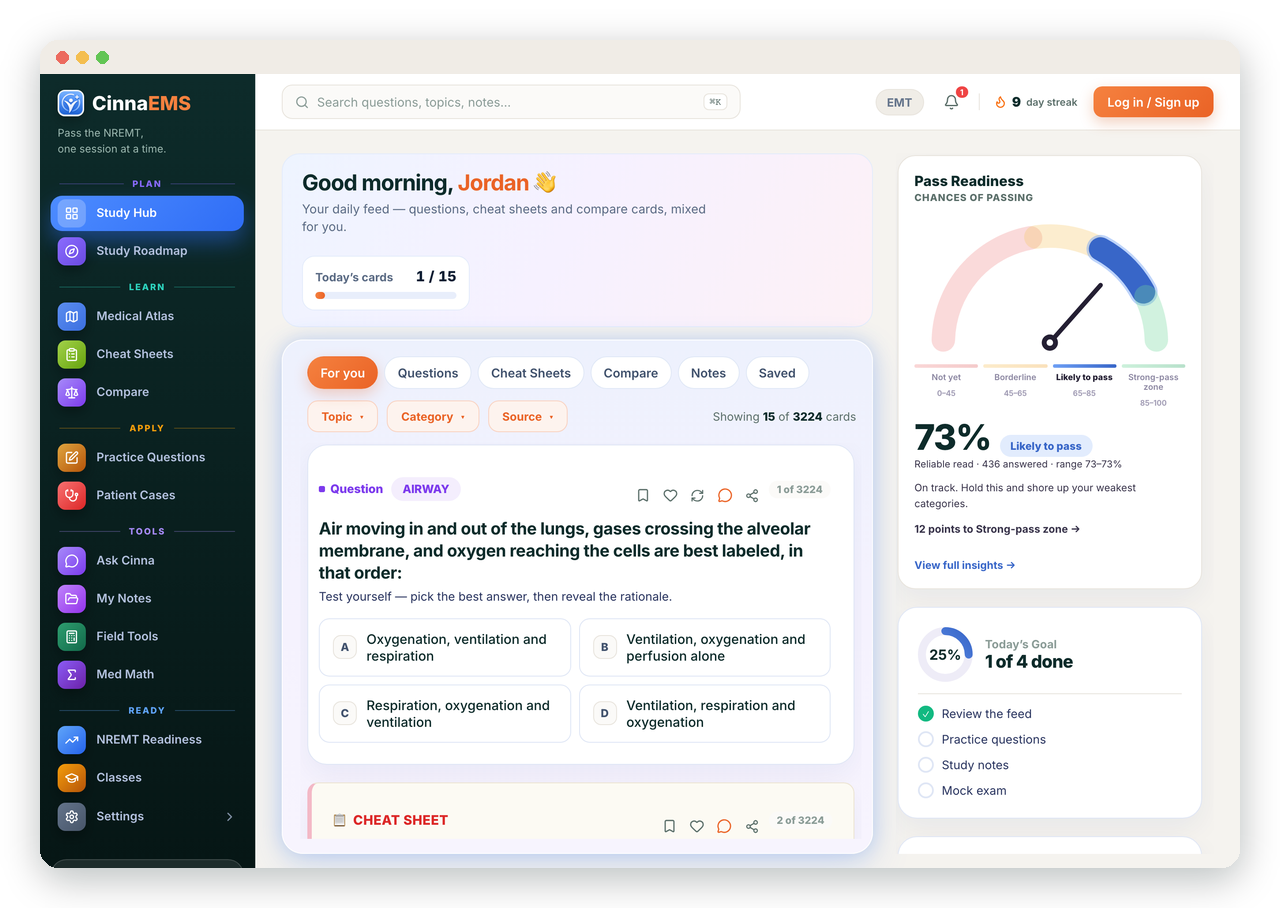
Evidence-based strategies, clear plans, and smart practice that fit your life.
Most candidates who struggle with the National Registry EMT exam did not skip the reading. They read everything — and then met questions that never asked them to recite a fact. The exam describes a patient and asks what you do next. A plan that trains recognition ("I have seen this") rather than decision-making ("this is what comes first") leaves you exposed on exactly the items that decide the result.
Know what you are sitting
The EMT exam is a computer-adaptive test of between 70 and 120 questions, with up to two hours. After each answer the test re-estimates your ability and chooses the next item to match it. It stops once it is confident — to a set statistical standard — that you are above or below the passing standard, or when you reach the maximum length. We explain that in detail in how the NREMT adaptive test works.
Study to the 2025 blueprint, not the old chapter list
The Registry reorganized the EMR and EMT exams around the order of a patient encounter. The five EMT domains and their approximate share of the exam:
| Domain | Share of the EMT exam |
|---|---|
| Primary Assessment | 39–43% |
| Patient Treatment & Transport | 20–24% |
| Scene Size-Up & Safety | 15–19% |
| EMS Operations | 10–14% |
| Secondary Assessment | 5–9% |
Two things follow. First, Primary Assessment alone is roughly two questions in every five: recognizing life threats, airway, breathing and circulation, and deciding priority. Second, the old habit of studying "cardiology week" then "trauma week" no longer matches how you are scored. A chest-pain question is now scored as primary assessment, treatment or scene safety depending on what it asks you to decide. The full change is covered in what changed in the 2025 NREMT exams.
Study questions first, chapters second
Reading builds familiarity; answering builds retrieval under pressure, which is what the exam measures. Flip the usual ratio:
- Most of your time in practice questions, and read the rationale for every option — including the ones you got right for the wrong reason.
- Targeted review only where your misses point. Let wrong answers write your reading list.
- Mixed sets, not topic blocks. The real exam moves between domains item to item. Practicing in blocks lets you guess the topic before you read the stem.
Train the decision the exam is really asking about
Most EMT items come down to one of a small number of decisions. Name the decision before you look at the options:
- Is the scene safe, and do I need more help? Scene safety comes before patient contact, every time.
- What kills this patient first? A threat to the airway, breathing or circulation outranks everything, including a dramatic-looking injury.
- What is the next step — not the eventual one? Several options are often correct care. Only one is correct now.
- Does this patient need to go now? Recognizing a patient who needs rapid transport is itself a scored skill.
A realistic four-week run-in
If you have finished your course, four focused weeks is enough for most candidates. Our four-week NREMT study plan lays it out day by day. In short: a baseline in week one, weak-domain drills in weeks two and three, full-length timed practice in week four, and a light final two days.
The final week
- Sit at least one full-length, timed practice exam to practice pacing — roughly a minute per question leaves time to spare.
- Review only what still trips you. New topics the night before add anxiety, not points.
- Sleep. Fatigue costs more marks than any single topic you could still cram.
Start with a diagnosis
If you do not know which domain is costing you the most, find out before you plan anything. The free NREMT Fast Check is fifteen EMT questions weighted like the real blueprint, with the rationale on every one and your two weakest domains named at the end — no account needed.