
💡
Pass with confidence.
Evidence-based strategies, clear plans, and smart practice that fit your life.
The Paramedic cognitive exam is adaptive, with 80 to 150 questions in 2 hours 30 minutes. It assumes everything below it on the ladder and adds the advanced assessment and treatment decisions that define paramedic practice.
The blueprint
| Domain | Share |
|---|---|
| Clinical Judgment | 34–38% |
| Medical, Obstetrics & Gynecology | 24–28% |
| Cardiology & Resuscitation | 10–14% |
| Airway, Respiration & Ventilation | 8–12% |
| EMS Operations | 8–12% |
| Trauma | 6–10% |
Three skills to build deliberately
- Clinical reasoning. More than a third of the exam gives you a patient and asks what the findings mean and what to do. See the Clinical Judgment domain, explained.
- Rhythm recognition with consequences. Recognizing a rhythm is half the item; knowing what it obliges you to do — and whether the patient is stable — is the other half.
- Calculation fluency. Dose-by-weight, volume and drip-rate problems are quick marks if the method is automatic. See EMS med math for the NREMT.
The Registry avoids regionally variable detail such as specific protocols and doses. Learn the principles and the national standards; your local protocols are for your practice, not this exam.
How to prepare
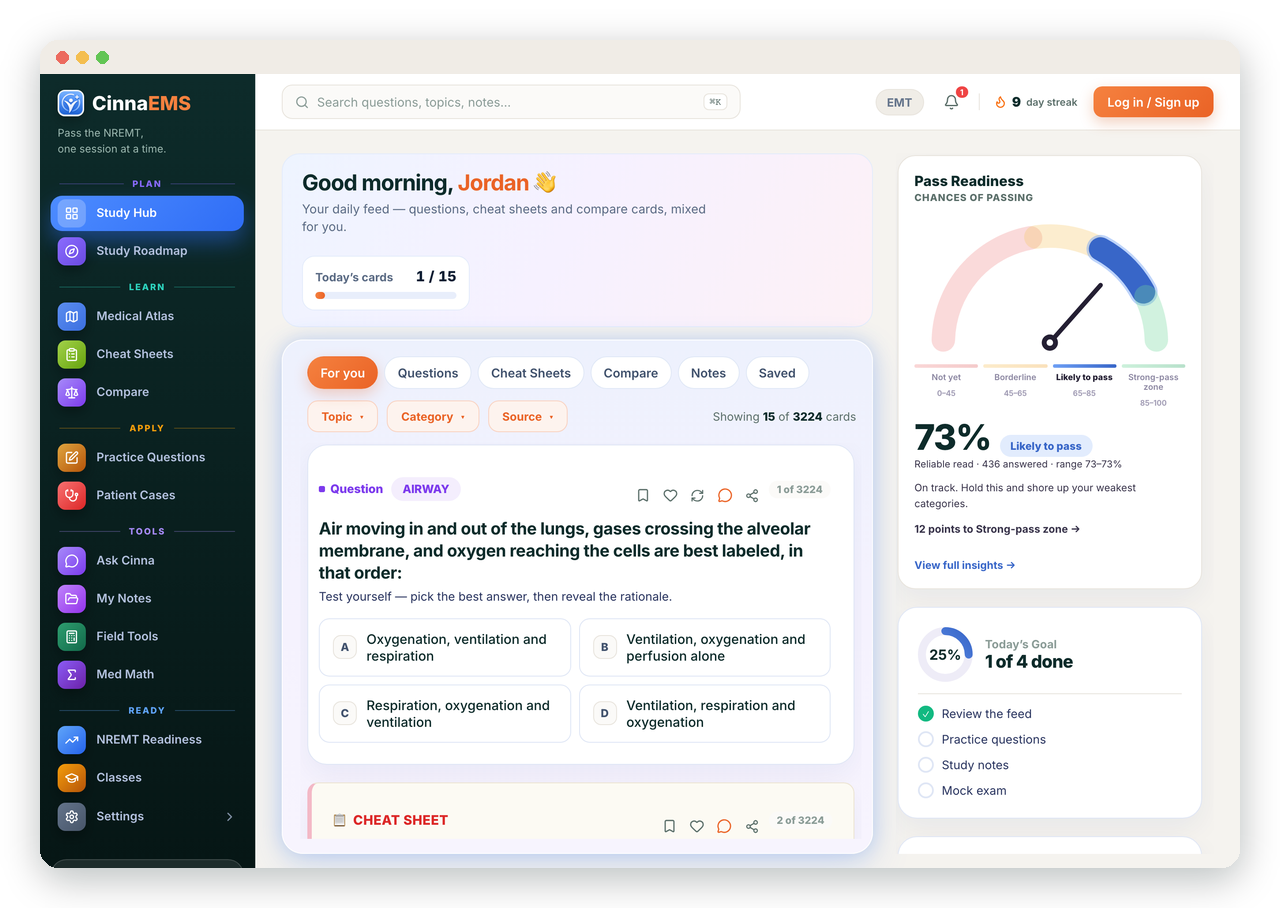
Work mixed, timed sets across all six domains and at least two full-length practice exams. CinnaEMS generates a fresh ECG strip for every rhythm question — so you learn the rhythm rather than a memorized picture — and new med-math problems every round, with the working shown.