
On this page
Where the AEMT fits
The National Registry certifies four EMS levels: Emergency Medical Responder (EMR), Emergency Medical Technician (EMT), Advanced EMT (AEMT) and Paramedic. The AEMT sits between EMT and paramedic. It is an advanced life support level, but with a much narrower set of advanced skills than a paramedic.
The National Registry's exam specifications describe what a newly certified AEMT should be able to do.
- Provide safe and effective emergency care by combining knowledge and skills across many patient presentations
- Assess and manage the safety of everyone involved in a call
- Assess the patient to find life threats and reduce death and disability without causing further harm
- Apply assessment findings to established clinical guidelines to choose interventions
- Adjust treatment as the patient's condition evolves, including input from higher-level providers
What AEMTs can do that EMTs can't
The National EMS Scope of Practice Model (2019) sets the national minimum for each level. At the AEMT level it adds skills such as peripheral IV and intraosseous (IO) access and nitrous oxide administration. AEMT medications are limited to a short list, including dextrose, epinephrine, glucagon, naloxone, analgesia and antiemetics, plus others defined by state or local protocol.
The model is a floor, not a guarantee. Your state and your medical director decide what you may actually do. The model's rule is that you perform a skill only if you are educated, certified, licensed and credentialed for it.
In practice, AEMT training centers on vascular access, fluids and a handful of high-impact drugs for problems like hypoglycemia, opioid overdose and anaphylaxis.
Check yourself
4 quick questions on this topic
Question 1 of 4
An AEMT is unable to start a peripheral IV after two attempts during an adult cardiac arrest. What is the best next step for vascular access?
Answer: A. When IV attempts fail in arrest, intraosseous access is a rapid, reliable alternative that does not interrupt compressions. Repeated peripheral attempts delay medications, pausing CPR for a line sacrifices perfusion, and deferring access entirely removes the route for resuscitation drugs that paramedic partners will need.
Question 2 of 4
An AEMT is starting an IV on a patient with a suspected acute stroke and a normal glucose. Which fluid decision is most appropriate?
Answer: A. Isotonic crystalloid at a keep-open rate provides access without harm. Extra glucose worsens outcomes in the ischemic brain, so dextrose is given only to treat measured hypoglycemia. A large bolus does not reopen a clot and can cause volume overload, and hypotonic fluid shifts water into brain cells, worsening cerebral edema.
Question 3 of 4
A patient with suspected sepsis and borderline blood pressure has two failed peripheral IV attempts and is worsening. What is the most appropriate access decision?
Answer: A. When a deteriorating patient needs fluid and peripheral access has failed, intraosseous access is fast, reliable and within AEMT scope. Repeated peripheral attempts burn minutes a shocked patient does not have, deferring all fluid wastes the prehospital window, and oral fluids are neither reliable volume nor safe in a patient whose mental status may decline.
Question 4 of 4
A family finds their 15-year-old son confused, with dilated pupils, hot dry skin and a heart rate of 136 after he ate seeds from a plant in the yard. He is picking at the air. What is the priority?
Answer: A. Jimsonweed and similar plants produce an anticholinergic toxidrome: delirium, dilated pupils, hot dry skin, tachycardia and hyperthermia. Care is supportive — protect from injury, manage ABCs, cool, rule out hypoglycemia and transport. Naloxone does not reverse anticholinergic effects and the pupils argue against opioids, while emesis and oral fluids risk aspiration in a delirious patient.
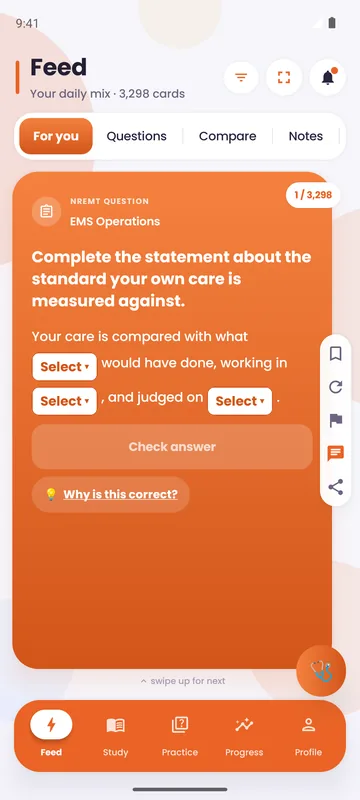
Keep the streak going with more questions like these, each with a full rationale.
Requirements for National Registry AEMT certification
For the full education program pathway, the National Registry requires the following.
Certification is not the same as permission to practice. You also need a state license to work as an AEMT, and states differ on whether they require National Registry certification for that license. Already licensed by your state? The National Registry has a separate state-licensed pathway built on a state-approved refresher course or 25 credits of continuing education.
- A current National Registry certification or state license at the EMT level or higher
- Successful completion of a state-approved AEMT course
- Course completion within the past two years
- Verification of your successful completion by the course Program Director on the National Registry website
- A passing result on the National Registry AEMT certification exam ($159 per attempt)
How long it takes to become an AEMT
There is no single national answer, because the National Registry does not set course hours. Your total time is the sum of a few pieces, and only some of them are fixed.
Before you enroll, ask programs for three numbers: total course hours, the clinical or field component, and how soon graduates usually test. Those numbers, not national rules, set your calendar.
- 1EMT firstYou must already hold an EMT credential before AEMT certification.
- 2The AEMT courseIts length is set by your state-approved program, so check its published schedule, including any clinical or field hours.
- 3The two-year windowYou must certify within two years of finishing the course.
- 4VerificationYour Program Director verifies completion before you can test.
- 5The examOne 3-hour sitting. If you fail, you wait 15 days before retesting.
- 6State licensureAllow time for your state EMS office to issue the license.
The AEMT exam format
Since July 1, 2024, AEMT certification uses one cognitive exam and no separate psychomotor exam. It is a fixed-length, computer-based test of 135 items in 3 hours, given at Pearson VUE test centers. Thirty-five of those items are unscored pilot items you cannot identify, so 100 count.
Every candidate gets the same number of items, though not the same items. You can change an answer before moving on, but not after. Any items left unanswered when time runs out are scored wrong. Scoring is all-or-nothing, with no partial credit.
What's on the AEMT exam
The exam covers six domains. Clinical judgment is the largest: with 100 scored items, roughly 31 to 35 of them test it.
Clinical judgment follows a cycle: recognize cues, analyze cues, define a hypothesis, generate solutions, take action and evaluate. Pediatric care is woven through every domain rather than tested on its own.
Retakes and how to prepare
AEMT is a fixed-length exam: all 100 scored items count and there is no partial credit, so steady preparation across the whole blueprint beats cramming one area. You get six attempts, must wait 15 days between them, and need remedial education after a third failure.
The quiz here pulls from the CinnaEMS bank of 4,646 questions, including 609 clinical judgment and 533 medical and OB-GYN questions.
- Study to the blueprint: clinical judgment and medical/OB-GYN together are more than half the exam.
- Practice fluid and drip-rate math until it is automatic.
- Know each AEMT drug's indications, contraindications and expected response under your state's protocol.
- Read capnography and vital-sign trends, not single values.
- Work through scenario sets, not just single questions, to build the clinical judgment cycle.
Frequently asked questions
How long is an AEMT course?
It depends on your state-approved program; the National Registry does not set course hours. It does require that you certify within two years of finishing the course.
Do you need to be an EMT to become an AEMT?
Yes. The National Registry requires a current National Registry certification or state license at the EMT level or higher.
Is there a skills (psychomotor) exam for AEMT?
Not from the National Registry since July 1, 2024. Certification uses one cognitive exam; your education program and state still verify your skills.
What is the AEMT exam like?
A fixed-length, 135-item computer-based exam with a 3-hour limit, given at Pearson VUE test centers. Thirty-five items are unscored, and there is no partial credit.
How much is the AEMT exam?
$159 per attempt, according to the National Registry.
Keep studying
Sources
Checked against official sources
- nrAEMT Full Education Program Pathway (National Registry)nremt.org
- nrNational Registry AEMT Examination Specificationsnremt.org
- nrAEMT Candidate Handbook: About the Examination (National Registry)nremt.org
- nrAEMT State-Licensed Pathway (National Registry)nremt.org
- emNational EMS Scope of Practice Model 2019 (NHTSA Office of EMS)ems.gov
- nrNational Registry Maps and Data (Annual Certification Reports)nremt.org