Ventilation is judged by chest rise, not by squeezing the bag.
Before you read
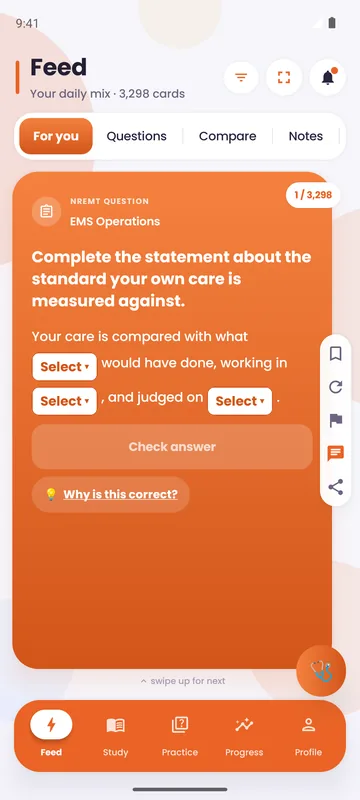
Test yourself first: 5 questions
Question 1 of 5
Which is the best reason to begin transport before a treatment has been finished?
Answer: A. Transport begins mid-treatment when the patient's remaining problem can only be solved somewhere else, and the treatment simply continues in the moving ambulance. A slow treatment, an unpleasant scene or family pressure are reasons about the crew and the bystanders rather than about what the patient's condition needs.
Question 2 of 5
Leaving a treatment out entirely because performing it would delay transport is defensible when:
Answer: A. The judgment is a comparison made for this patient: what the intervention gains them set against what the minutes cost them, which is why the same treatment is right on one call and wrong on the next. Crew familiarity is a training issue, an unrequested treatment is still indicated, and a hospital doing it better never answers whether this patient can safely wait for it.
Question 3 of 5
A patient who refuses one treatment but accepts the rest should have:
Answer: A. A refusal covers the thing refused and nothing else, so the rest of the care goes ahead and the declined item is documented with the explanation given. Withdrawing all care punishes a lawful decision, treating someone who is distracted is a battery, and transport without treatment abandons care the patient never refused.
Question 4 of 5
You need a treatment that is within your scope but you have no equipment for it. You should:
Answer: A. Most BLS treatments have an improvised form — hands, padding, a blanket, a bystander — so the principle is delivered with what is on hand while the missing item is requested. Going without leaves the problem untreated, forcing an unsuitable device injures the patient, and holding the transport costs more than the equipment was worth.
Question 5 of 5
Two treatments both look urgent and you have a partner with you. The best use of the crew is:
Answer: A. Two providers mean two treatments can run at once, and that parallel work is exactly what a two-person crew is for, with one person keeping overall direction. Working both problems in series leaves one untreated for as long as the other takes, and deferring an urgent treatment because of rank treats the crew's structure as the priority.
Keep the streak going with more questions like these, each with a full rationale.
What is treatment & transport?
Roughly a fifth of both entry-level exams. The recurring theme is that an intervention is judged by its effect, not by whether it was performed.
Key points to remember
- Ventilation is judged by chest rise, not by squeezing the bag.
- Oxygen is a drug with indications, not a routine comfort measure.
- Pulse, motor and sensation before AND after every splint.
- Time-critical bleeding you cannot reach means minimal scene time and early notification.
Field priorities
- Let a breathing patient keep the position they chose.
- Fit devices around compressions rather than pausing for them.
Coaching the patient
- An impaled object may be the only thing stopping the bleeding.
Red flags: act now
- Deterioration after sealing a chest wound — suspect tension
- A distal pulse lost after splinting
- Hypotension with a pelvic fracture
Treatment & Transport: FAQs
What are the priority actions for Treatment & Transport in the field?
Let a breathing patient keep the position they chose. Fit devices around compressions rather than pausing for them.
What findings in Treatment & Transport change your plan or your transport decision?
Deterioration after sealing a chest wound — suspect tension. A distal pulse lost after splinting. Hypotension with a pelvic fracture.
What do I need to know about Treatment & Transport for the NREMT?
Ventilation is judged by chest rise, not by squeezing the bag. Oxygen is a drug with indications, not a routine comfort measure. Pulse, motor and sensation before AND after every splint. Time-critical bleeding you cannot reach means minimal scene time and early notification.
What should the crew communicate or document for Treatment & Transport?
An impaled object may be the only thing stopping the bleeding.