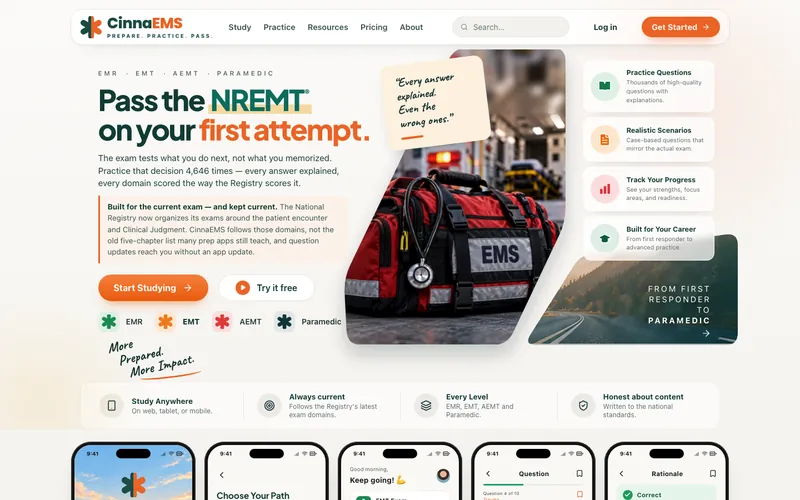
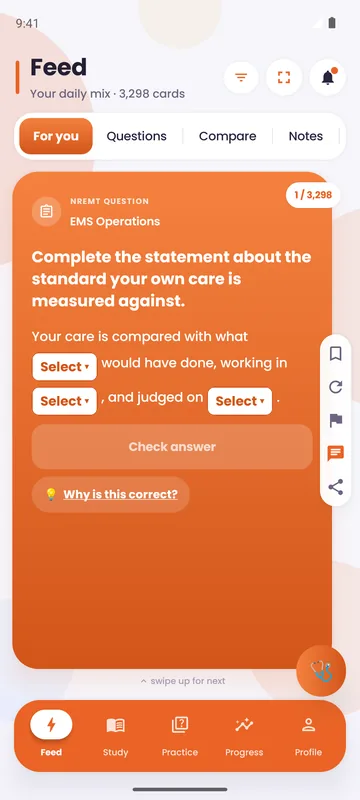
Questions written the way the National Registry writes them — a scenario, four plausible options and a rationale that explains the whole answer, not just the letter. Below them, the exam you are actually sitting.
The AEMT cognitive exam is a linear exam of exactly 135 questions with up to 180 minutes. It is not adaptive: every candidate answers the same fixed form, so pace yourself against the clock rather than watching the question count. Advanced EMT candidates are the bridge level: EMT scope plus a defined set of advanced skills.
Try six
Question 1 of 6
A 74-year-old who takes a beta-blocker and has long-standing high blood pressure fell down a flight of stairs. His heart rate is 76, pressure 104/70, and his skin is cool and pale. How should you interpret these findings?
Answer: A. Analyze cues: a beta-blocker prevents the compensatory tachycardia you rely on, and a systolic of 104 in someone whose usual pressure is high can represent a large drop. Cool, pale skin is the cue that betrays hypoperfusion. Neurogenic shock produces warm, dry skin below the injury, and calling the numbers 'normal' ignores both his medication and his baseline.
Question 2 of 6
The head delivers and then retracts tightly back against the perineum, and the shoulders do not follow with the next contraction. This is:
Answer: A. The turtle sign means the anterior shoulder is caught behind the pubic bone while the cord is compressed, and the baby has only minutes — sharply flexing the mother's hips and applying suprapubic pressure are the maneuvers used while transport continues. Waiting it out as though it were a normal pause costs the oxygen the baby no longer has.
Question 3 of 6
A patient with suspected ACS has no aspirin allergy. Which history is the strongest reason to withhold aspirin?
Answer: A. Aspirin irreversibly blocks platelet thromboxane production, so active gastrointestinal bleeding — melena or hematemesis — is a clear reason to withhold it. Daily aspirin use is not a reason to withhold, simple heartburn is not active bleeding, and well-controlled asthma without known aspirin-induced bronchospasm is not a contraindication.
Question 4 of 6
Each bag-valve-mask breath should be delivered over about one second rather than as a fast squeeze, because a rapid breath:
Answer: A. Gas takes the path of least resistance, and a fast squeeze raises pressure past what the esophageal opening will hold, so part of every breath goes to the stomach. A slow, smooth delivery keeps pressure below that threshold. Volume is set by how far you squeeze, not by how fast, which is why speed buys nothing and costs the airway.
Question 5 of 6
A marathon runner collapses, is confused and has a core temperature of 41.5°C. Which intervention most improves survival?
Answer: A. Exertional heat stroke is a time-critical emergency: the duration of extreme hyperthermia drives organ damage, so rapid cooling — ideally cold-water immersion — is started on scene. Oral fluids are for heat exhaustion in an alert patient; antipyretics do not work because the hypothalamic set point is not raised; delaying cooling for transport worsens outcome.
Question 6 of 6
An error of yours has reached the patient and they are awake and asking what just happened. You should:
Answer: A. It happened to them, in their body, and they are the one person with an unarguable claim on the facts — a plain account is also what preserves any trust the rest of the call earned. Routing it only to the clinician treats the patient as the subject of the conversation rather than a party to it, and waiting for a review answers a question that has already been asked.
Keep the streak going with more questions like these, each with a full rationale.
The National Registry publishes the share of the exam each domain is worth. These are the current bands — the ones the AEMT blueprint has used since the 2025 restructure, not the retired five-domain plan that much of the older material online still follows.
| Domain | Share of the exam | Free questions |
|---|---|---|
| Airway, Respiration & Ventilation | 9–13% | Practice airway, respiration & ventilation |
| Cardiology & Resuscitation | 11–15% | Practice cardiology & resuscitation |
| Trauma | 7–11% | Practice trauma |
| Medical, Obstetrics & Gynecology | 25–29% | Practice medical, obstetrics & gynecology |
| EMS Operations | 6–10% | Practice ems operations |
| Clinical Judgment | 31–35% | Practice clinical judgment |
Study the weight, not the syllabus order. Clinical Judgment is 31–35% of your exam. A weak domain that is also a heavy one is worth more of your week than everything else put together.
Everything below is free on this site, no account:
And the explainers: how the exam is scored, how the adaptive test decides, and the cheat sheets.
The AEMT cognitive exam is linear: exactly 135 questions, of which 35 are unscored pilot items, with a limit of 180 minutes. Everyone sits the same number.
Airway, Respiration & Ventilation 9–13%, Cardiology & Resuscitation 11–15%, Trauma 7–11%, Medical, Obstetrics & Gynecology 25–29%, EMS Operations 6–10%, Clinical Judgment 31–35%. The heaviest domain is where a retake is usually won or lost.
The AEMT exam is linear, so every candidate answers the same number of questions. Length says nothing about anyone's result.
Six attempts in total. After three unsuccessful attempts you must document remedial training before testing again, and after six you repeat a state-approved education program.
Free to start
4,600+ NREMT-style questions, clinical judgment scenarios and timed mock exams. Free every day, and it works offline.