
On this page
The short answer
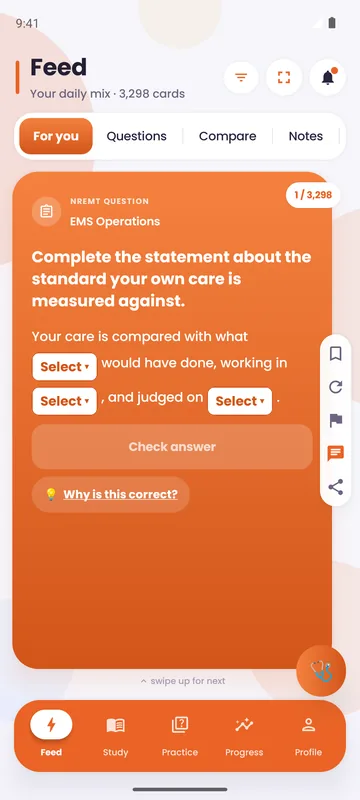
Most NREMT questions are still classic multiple choice: one correct answer out of four. But every level now mixes in technology-enhanced items (TEIs). They test the same knowledge in a different way: putting steps in order, sorting findings into categories, or picking more than one correct answer.
The National Registry added TEIs to the AEMT and paramedic exams in 2023. The updated EMR and EMT exams, live since April 7, 2025, include them too. If your instructor or an older study guide says 'it's all multiple choice,' that's out of date.
Every item type, explained
NREMT's paramedic specifications define the full set. The EMR/EMT exam page lists the three TEI types used there: build list, drag-and-drop and option/check box.
Check yourself
4 quick questions on this topic
Question 1 of 4
The fairest measure of whether a primary assessment was well done is:
Answer: A. The sequence, the documentation and the clinical reasoning all exist to serve one output — a judgment about how sick this patient is, made early enough to change what happens to him. A perfectly ordered assessment that arrived at a low priority for a deteriorating patient has failed, and matching the hospital's diagnosis was never the task, because the primary assessment was never trying to name the problem.
Question 2 of 4
During the primary assessment of a trauma patient you find severe bleeding from a thigh wound. You should:
Answer: A. A femoral wound can exsanguinate a patient faster than an airway problem will kill them, which is why massive hemorrhage is corrected the moment it is found rather than deferred to a later step. Sequence in the primary assessment is about what kills soonest, not a fixed running order.
Question 3 of 4
You applied a tourniquet to a bleeding leg and continued the primary assessment. Two minutes later the dressing beneath it is soaked again. The correct action is:
Answer: A. Continued bleeding means arterial flow has not been stopped, and the fix is more pressure, either by tightening or by adding a second device proximal to the first. Loosening a tourniquet to let blood back in restarts the hemorrhage you controlled and costs volume the patient cannot spare.
Question 4 of 4
The resuscitation of a traumatic cardiac arrest is organized around reversible causes rather than around the monitor because:
Answer: A. The heart in a traumatic arrest usually stopped because it had nothing to pump, could not fill, or was not being oxygenated, and none of those is corrected by a defibrillator — so hemorrhage control, ventilation, decompression and volume come first. Monitors do work at a crash, and rhythm assessment is quick; it simply does not change what this patient needs.
Keep the streak going with more questions like these, each with a full rationale.
How they're scored
For the paramedic exam, NREMT states that all items are scored dichotomously. You get full credit for a fully correct response and nothing for a partly correct one. On a multiple-response item, picking two of the three right answers earns the same as picking none. Read the instruction line ('Select the two answer options that are correct') before you look at the options.
Every level also includes unscored pilot items mixed in with the scored ones. You can't tell which they are, so treat every item, including every TEI, as if it counts.
Worked example: a multiple-response item
A patient trapped under a fallen shelf has a crushed lower leg. They're anxious, with pale, cool skin. Which two findings most support early (compensated) shock? Select two. A. Heart rate 124. B. Blood pressure 82/50. C. Delayed capillary refill. D. Heart rate 48. E. Warm, flushed skin.
Correct: A and C. In compensated shock the body keeps blood pressure up by raising the heart rate and clamping down peripheral circulation, which shows up as a fast pulse and slow capillary refill. Low blood pressure (B) is a late sign that means compensation is failing. Bradycardia (D) and warm, flushed skin (E) don't fit early blood-loss shock. Choosing A and B gets no credit, even though A is right.
Worked example: a build list item
Put these in order for an adult found unresponsive: check breathing and pulse; ensure scene safety; begin chest compressions; check responsiveness; call for help and an AED.
Order: ensure scene safety, check responsiveness, call for help and an AED, check breathing and pulse (no more than 10 seconds), begin chest compressions. Build list items reward knowing a sequence cold. Practice saying your assessments out loud in order until you can't get them wrong.
What else is in the NREMT process
For AEMT and paramedic candidates, the exam changed on July 1, 2024. It's now one examination, with no separate psychomotor exam. Clinical judgment is built into the test itself. On the paramedic exam it's the largest domain at 34–38%, and 30% of the cardiology and resuscitation domain uses ECG rhythm strips.
For EMR and EMT, check skills and course requirements with your program director and state EMS office. A blank skills section in your NREMT account usually means a step your program or state still has to record, not a problem with your written exam.
How to get comfortable with TEIs
Use the tutorial at the start of the exam; it explains each item type, and the Help function brings it back at any time. In practice, turn your notes into sequences (primary assessment, CPR, patient packaging) and categories (signs of compensated vs decompensated shock, stroke vs hypoglycemia findings). Those are exactly what build list and drag-and-drop items test.
The CinnaEMS bank has 4,646 questions, including 731 in primary assessment and 609 in clinical judgment. Take the practice quiz on this page, then do a timed set in your weakest domain.
Frequently asked questions
Is the NREMT all multiple choice?
No. Most items are four-option multiple choice, but every level includes technology-enhanced items such as build list, drag-and-drop and option/check box. Paramedic and AEMT exams also use multiple-response and graphical items.
Is the EMT test multiple choice?
Mostly. Since April 7, 2025, the NREMT EMT exam also includes build list, drag-and-drop and option/check box items. A tutorial at the start shows how each one works.
Is there partial credit on the NREMT?
NREMT's paramedic specifications say items are scored dichotomously: full credit only for a fully correct response, and no credit for a partly correct one.
What does the NREMT exam consist of?
A computer-based cognitive exam organized by domains. For the EMT exam those are scene size-up and safety, primary assessment, secondary assessment, patient treatment and transport, and operations. AEMT and paramedic certification has been one exam with no separate psychomotor test since July 1, 2024.
What exams do you need to be a paramedic?
For national certification, the NREMT paramedic certification examination, which since July 1, 2024 includes clinical judgment and has no separate psychomotor exam. Your state may add its own licensing steps.
Keep studying
Sources
Checked against official sources