
On this page
The numbers: 2025 by level
The National Registry publishes an annual certification report. In its 2025 report, the share of candidates passing the certification examination was as follows.
The report labels these as the percent passing the exam; it does not say they are first-attempt rates, so do not read them that way.
So is it hard? Hard enough that about one in five EMT candidates did not pass, and AEMT is the toughest level by this measure. But it is very passable with targeted prep.
Why it feels harder than your class exams
Most of the exam's reputation comes from how it is built, not from obscure content. The EMT and paramedic exams use computerized adaptive testing. After an initial set of items, the computer gives you questions targeted at or above your estimated ability. If you are doing well, the questions get harder, so almost everyone leaves feeling unsure.
Scoring adds pressure. All items are scored all-or-nothing: full credit for a fully correct response, nothing for a partially correct one. On a multiple-response item that asks for two or three correct answers out of five or six options, getting one wrong means zero for that item.
Then there is exam length. Otherwise it continues until the maximum number of items or the time limit. A short exam does not mean you failed, and a long one does not mean you passed.
Check yourself
4 quick questions on this topic
Question 1 of 4
A patient is awake but will not follow commands and keeps pulling at your equipment. In the primary assessment, your greatest concern with this behavior is that:
Answer: A. A patient who cannot follow simple commands has lost the coordinated control that keeps secretions and vomit out of the trachea, which makes this an airway problem before it is anything else. Crew safety and consent matter, but neither kills the patient in the next few minutes the way aspiration can.
Question 2 of 4
An electrician was shocked at the top of a ladder and fell to the ground. Your primary assessment must account for:
Answer: A. Two mechanisms acted on this patient, so you are looking for the respiratory and cardiac effects of current and for the airway, breathing and bleeding problems of a fall from height at the same time. Choosing one mechanism narrows the assessment to half the injuries, and it is usually the spectacular one that gets the attention while the quieter one does the killing.
Question 3 of 4
Every time you ask the patient a question, her daughter answers for her. To complete the mental status part of your primary assessment you must:
Answer: A. The sound of a patient's own voice answers two questions at once, because an answer means the airway is open and the brain is working well enough to build the sentence, and no relative can supply either finding. Taking the daughter's account instead leaves mental status unassessed, and ordering her out of her own home costs you the best history on the scene in exchange for nothing.
Question 4 of 4
A crew working a chaotic scene fixes on one dramatic injury and misses an obstructed airway. This is an example of:
Answer: A. Acute stress narrows attention onto whatever is most vivid, which is how a visible wound captures a crew while a quiet airway problem goes unseen. Blaming training misses the point, since the crew knows the airway comes first; the countermeasure is a deliberate, repeated primary assessment.
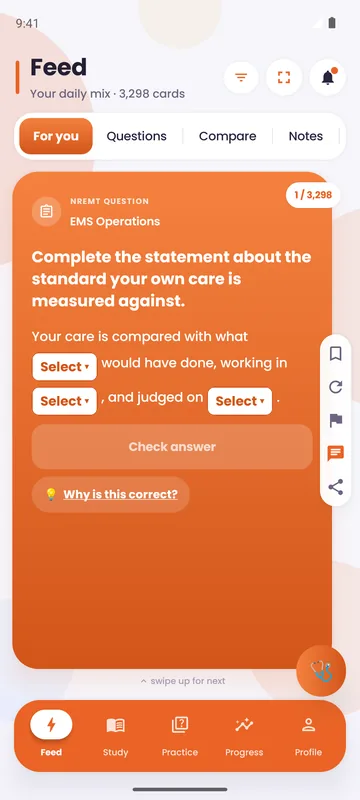
Keep the streak going with more questions like these, each with a full rationale.
Exam format by level
The current EMT exam launched in spring 2025, based on a 2023 practice analysis. The AEMT and paramedic exams changed on July 1, 2024, when the separate psychomotor exam was dropped for those levels.
What the EMT exam actually tests
The EMT exam has five content domains. Their weights tell you where the points are.
Primary assessment alone is about two of every five scored questions. It covers your general impression, level of consciousness, airway, breathing, circulation, chief complaint and life threats, and the call on rapid treatment or transport. If your study time does not reflect that, rebalance it. In the CinnaEMS bank of 4,646 questions, primary assessment is also the largest category, with 731 questions.
- Secondary Assessment: 5–9%
Scoring: what 950 means
Per the EMT candidate handbook, results are reported on a scale from 100 to 1500, and the passing point is 950. The passing standard is the same for every candidate. It comes from a standard-setting study in which a panel of EMS subject matter experts, guided by a psychometrician, recommends a cut score to the National Registry Board of Directors.
Do not try to convert 950 into a percent. Because the exam adapts, two candidates answer different numbers and difficulties of items. What matters is whether your ability estimate clears the standard. Results generally post within two business days, as long as your other requirements are met.
If you don't pass: attempts and waits
You get six chances to pass. After a failed attempt, you must wait 15 days from your last exam date before testing again. After three failures, you must complete remedial education before your fourth attempt.
This week's r/NewToEMS has 'Failed my first attempt on the NREMT' right next to two 'passed first try' posts. A first fail is common enough to recover from. Use the 15 days to drill your weakest domain instead of rereading the whole textbook.
How to make it feel easier
You do not need to know every page of your textbook equally. Match your prep to the blueprint and the format.
The quiz on this page pulls primary assessment, airway and shock questions, the core of the EMT exam.
- Practice multiple-response items until you can pick exactly the number asked, with confidence.
- Say your assessment sequence out loud on every scenario: scene safety, general impression, ABCs, then decisions.
- Learn the 'magic numbers', such as CPR rates and depths, inside scenarios, not as a flashcard list.
- Take at least two timed practice sessions at your level's real time limit.
Frequently asked questions
How many questions are on the EMT exam?
Between 70 and 120, with a 2-hour limit. Ten are unscored pilot items.
Is the NREMT exam multiple choice?
Mostly, but not only. You will also see multiple-response, options table, build list and drag-and-drop items. Every item is all-or-nothing, with no partial credit.
Is the NREMT exam online?
The EMT exam can be taken at a Pearson VUE test center or at home or the office through Pearson VUE's OnVUE online proctoring. AEMT and paramedic exams are given at Pearson VUE test centers.
What score do you need to pass the NREMT?
On the EMT exam, scores run from 100 to 1500 and the passing point is 950. The standard is the same for every candidate.
Keep studying
Sources
Checked against official sources
- nrNational Registry Maps and Data (Annual Certification Reports)nremt.org
- nrNational Registry EMT Examination Specificationsnremt.org
- nrEMT Candidate Handbook: About the Examination (National Registry)nremt.org
- nrNational Registry Paramedic Examination Specificationsnremt.org
- nrAEMT and Paramedic Certification Examinations (National Registry)nremt.org
- nrAEMT Candidate Handbook: About the Examination (National Registry)nremt.org