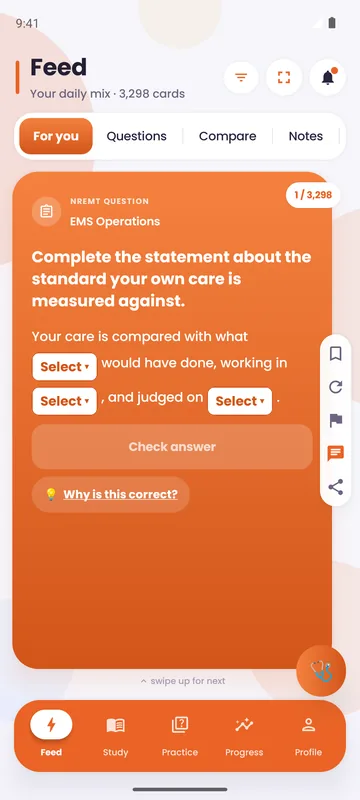
Questions written the way the National Registry writes them — a scenario, four plausible options and a rationale that explains the whole answer, not just the letter. Below them, the exam you are actually sitting.
The Paramedic cognitive exam is a computer-adaptive test of 110–150 questions with up to 210 minutes. It is adaptive: after each answer it re-estimates your ability, picks the next question to match, and stops once it is confident you are above or below the passing standard. Paramedic candidates are the highest National Registry level, examined on the full clinical blueprint.
Try six
Question 1 of 6
A 74-year-old who takes a beta-blocker and has long-standing high blood pressure fell down a flight of stairs. His heart rate is 76, pressure 104/70, and his skin is cool and pale. How should you interpret these findings?
Answer: A. Analyze cues: a beta-blocker prevents the compensatory tachycardia you rely on, and a systolic of 104 in someone whose usual pressure is high can represent a large drop. Cool, pale skin is the cue that betrays hypoperfusion. Neurogenic shock produces warm, dry skin below the injury, and calling the numbers 'normal' ignores both his medication and his baseline.
Question 2 of 6
A patient with myasthenia gravis has drooping eyelids, a weak voice and weakness that worsens the longer they exert themselves. The greatest danger is:
Answer: A. The disease attacks the junction between nerve and muscle, and the diaphragm and intercostals fail along with everything else, so a myasthenic crisis is a ventilation emergency and these patients are watched for a falling tidal volume rather than for a falling saturation. The condition is purely motor, so spreading sensory loss belongs to a different disease entirely.
Question 3 of 6
A patient with suspected ACS has no aspirin allergy. Which history is the strongest reason to withhold aspirin?
Answer: A. Aspirin irreversibly blocks platelet thromboxane production, so active gastrointestinal bleeding — melena or hematemesis — is a clear reason to withhold it. Daily aspirin use is not a reason to withhold, simple heartburn is not active bleeding, and well-controlled asthma without known aspirin-induced bronchospasm is not a contraindication.
Question 4 of 6
Each bag-valve-mask breath should be delivered over about one second rather than as a fast squeeze, because a rapid breath:
Answer: A. Gas takes the path of least resistance, and a fast squeeze raises pressure past what the esophageal opening will hold, so part of every breath goes to the stomach. A slow, smooth delivery keeps pressure below that threshold. Volume is set by how far you squeeze, not by how fast, which is why speed buys nothing and costs the airway.
Question 5 of 6
Which set of findings is Beck's triad of pericardial tamponade?
Answer: A. Blood in the pericardial sac limits filling: output falls (hypotension), venous return backs up (distended neck veins) and fluid around the heart dampens the sounds (muffled tones). Hypertension, bradycardia and irregular breathing are Cushing's triad; tracheal deviation with hyperresonance describes tension pneumothorax.
Question 6 of 6
An error of yours has reached the patient and they are awake and asking what just happened. You should:
Answer: A. It happened to them, in their body, and they are the one person with an unarguable claim on the facts — a plain account is also what preserves any trust the rest of the call earned. Routing it only to the clinician treats the patient as the subject of the conversation rather than a party to it, and waiting for a review answers a question that has already been asked.
Keep the streak going with more questions like these, each with a full rationale.
The National Registry publishes the share of the exam each domain is worth. These are the current bands — the ones the Paramedic blueprint has used since the 2025 restructure, not the retired five-domain plan that much of the older material online still follows.
| Domain | Share of the exam | Free questions |
|---|---|---|
| Airway, Respiration & Ventilation | 8–12% | Practice airway, respiration & ventilation |
| Cardiology & Resuscitation | 10–14% | Practice cardiology & resuscitation |
| Trauma | 6–10% | Practice trauma |
| Medical, Obstetrics & Gynecology | 24–28% | Practice medical, obstetrics & gynecology |
| EMS Operations | 8–12% | Practice ems operations |
| Clinical Judgment | 34–38% | Practice clinical judgment |
Study the weight, not the syllabus order. Clinical Judgment is 34–38% of your exam. A weak domain that is also a heavy one is worth more of your week than everything else put together.
Everything below is free on this site, no account:
And the explainers: how the exam is scored, how the adaptive test decides, and the cheat sheets.
The Paramedic cognitive exam is adaptive: between 110 and 150 questions, including unscored pilot items, with a limit of 210 minutes. It ends when the exam is confident which side of the passing standard you are on.
Airway, Respiration & Ventilation 8–12%, Cardiology & Resuscitation 10–14%, Trauma 6–10%, Medical, Obstetrics & Gynecology 24–28%, EMS Operations 8–12%, Clinical Judgment 34–38%. The heaviest domain is where a retake is usually won or lost.
Neither. On an adaptive exam the length tells you how quickly the test became confident, not which way it decided. Candidates pass at the minimum length and fail at it.
Six attempts in total. After three unsuccessful attempts you must document remedial training before testing again, and after six you repeat a state-approved education program.
Free to start
4,600+ NREMT-style questions, clinical judgment scenarios and timed mock exams. Free every day, and it works offline.