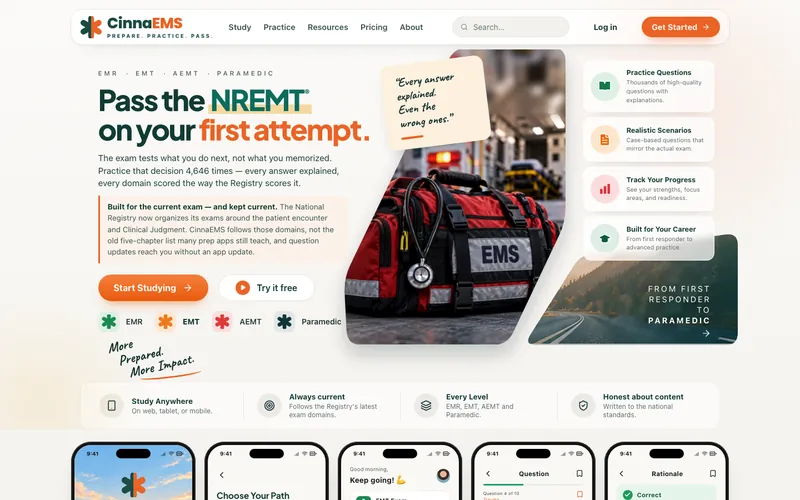
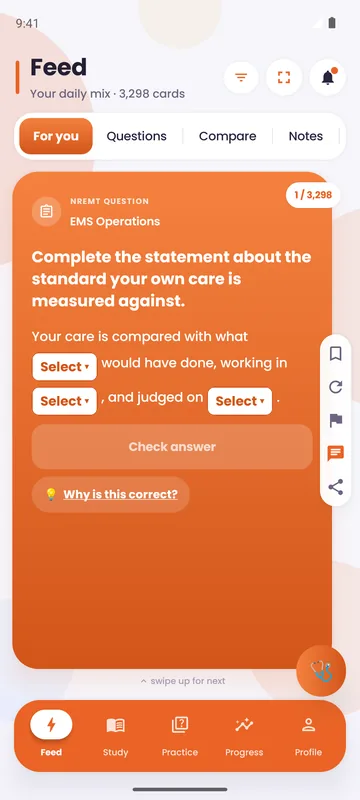
Questions written the way the National Registry writes them — a scenario, four plausible options and a rationale that explains the whole answer, not just the letter. Below them, the exam you are actually sitting.
The EMT cognitive exam is a computer-adaptive test of 70–120 questions with up to 120 minutes. It is adaptive: after each answer it re-estimates your ability, picks the next question to match, and stops once it is confident you are above or below the passing standard. Emergency Medical Technician candidates are the largest certification level in US EMS, and the one most people sit first.
Try six
Question 1 of 6
Under a hybrid SUV that has rolled over you see bright orange cables that have been torn. The correct response is to:
Answer: A. Orange cabling is the standard marking for high voltage in electric and hybrid cars, and torn cables can be live. The fire service shuts the car down. The crew's job is to keep everyone and everything away from the cables. Examination gloves give no electrical protection, and taping or pulling damaged high-voltage cable is not EMS work.
Question 2 of 6
A bystander says a man "had a seizure" for about 15 seconds right as he collapsed and now he is making occasional snorting gasps. What should you suspect first?
Answer: A. Brief jerking at the moment of collapse is a common result of sudden loss of blood flow to the brain, and occasional gasps are agonal breathing, not effective ventilation. Together they are a cardiac arrest until a pulse check proves otherwise. Calling it a postictal state is the trap: it delays compressions and defibrillation for a patient whose heart is not pumping.
Question 3 of 6
A nursing-home resident is confused. The single most useful question to ask the staff is:
Answer: A. Confusion only means something once you know the baseline, and the staff who see her every day are the only people on scene who can supply it. How long she has lived there and who her family are may be useful later for contact, but neither answers the one question that decides whether this is an emergency or her normal condition.
Question 4 of 6
An unresponsive patient started breathing better the moment you opened the airway with a jaw thrust. You should:
Answer: A. The improvement exists only for as long as the maneuver is held, which makes it a state to maintain rather than a task you have finished; letting go returns the tongue to exactly where it was. Repeating a maneuver already in place achieves nothing, and swapping technique for convenience trades the patient's airway for your hands.
Question 5 of 6
An error of yours has reached the patient and they are awake and asking what just happened. You should:
Answer: A. It happened to them, in their body, and they are the one person with an unarguable claim on the facts — a plain account is also what preserves any trust the rest of the call earned. Routing it only to the clinician treats the patient as the subject of the conversation rather than a party to it, and waiting for a review answers a question that has already been asked.
Question 6 of 6
Your patient's relatives are gathering behind you while you work on the floor. The adjustment worth making is:
Answer: A. You do not need the family gone, you need them in view, and a small shift of your own position achieves that without making anybody an adversary. Ordering relatives out of their own house creates the conflict you were avoiding, ignoring a group at your back gives up your warning, and posting your partner as a guard takes them off the patient.
Keep the streak going with more questions like these, each with a full rationale.
The National Registry publishes the share of the exam each domain is worth. These are the current bands — the ones the EMT blueprint has used since the 2025 restructure, not the retired five-domain plan that much of the older material online still follows.
| Domain | Share of the exam | Free questions |
|---|---|---|
| Scene Size-Up & Safety | 15–19% | Practice scene size-up & safety |
| Primary Assessment | 39–43% | Practice primary assessment |
| Secondary Assessment | 5–9% | Practice secondary assessment |
| Patient Treatment & Transport | 20–24% | Practice patient treatment & transport |
| EMS Operations | 10–14% | Practice ems operations |
Study the weight, not the syllabus order. Primary Assessment is 39–43% of your exam. A weak domain that is also a heavy one is worth more of your week than everything else put together.
Everything below is free on this site, no account:
And the explainers: how the exam is scored, how the adaptive test decides, and the cheat sheets.
The EMT cognitive exam is adaptive: between 70 and 120 questions, including unscored pilot items, with a limit of 120 minutes. It ends when the exam is confident which side of the passing standard you are on.
Scene Size-Up & Safety 15–19%, Primary Assessment 39–43%, Secondary Assessment 5–9%, Patient Treatment & Transport 20–24%, EMS Operations 10–14%. The heaviest domain is where a retake is usually won or lost.
Neither. On an adaptive exam the length tells you how quickly the test became confident, not which way it decided. Candidates pass at the minimum length and fail at it.
Six attempts in total. After three unsuccessful attempts you must document remedial training before testing again, and after six you repeat a state-approved education program.
Free to start
4,600+ NREMT-style questions, clinical judgment scenarios and timed mock exams. Free every day, and it works offline.