
On this page
The EMT timeline at a glance
Here is the full path, with the steps that take real calendar time:
- 1State-approved EMT courseThe longest step. Your state and program set the hours.
- 2BLS skills competencyApproved by your State EMS Office; many programs build it into the course.
- 3National Registry applicationSubmit about four weeks before your program ends.
- 4Authorization to Test (ATT)Up to 90 days from issue to schedule and take the exam.
- 5Cognitive examComputer adaptive, 70 to 120 questions, 2-hour limit.
- 6ResultsPosted to your National Registry account within 1–2 business days.
- 7State licenseApply through your State EMS Office, which sets its own process.
The course is the long part
The National Registry requires a state-approved EMT course that meets or exceeds the National EMS Education Standards, but it doesn't set the hours. States do. California's EMS regulations are a clear example: the EMT course must be at least 170 hours, with at least 146 hours of classroom instruction and skills lab and at least 24 hours of supervised clinical experience, including 10 documented patient contacts. High-fidelity simulation can replace up to 6 of those clinical hours.
How that becomes calendar time depends on the schedule. A 170-hour course taught full time can fit into a few weeks, while the same hours spread over evenings or a college semester take several months, and some programs run longer than the minimum. Ask any program for its total hours, schedule and clinical requirements before you enroll, and confirm it's approved by your State EMS Office.
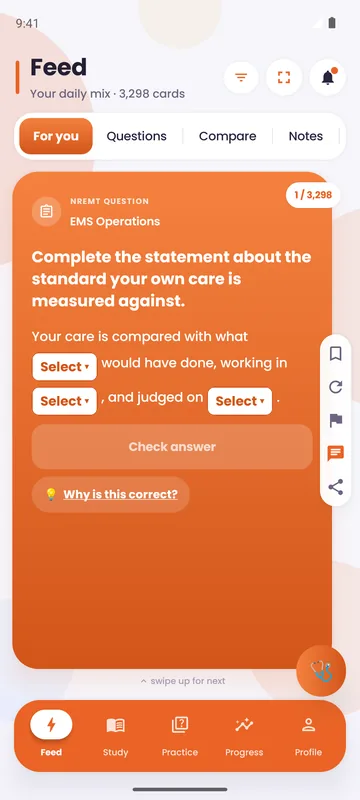
Check yourself
4 quick questions on this topic
Question 1 of 4
Which patient found during your primary assessment is the highest transport priority?
Answer: A. Priority is set by threat to airway, breathing or circulation, and a weak pulse with a depressed level of consciousness is both a perfusion problem and an airway risk. A deformed ankle with intact distal pulses is painful but not time critical, and controlled bleeding is by definition no longer a life threat.
Question 2 of 4
Which statement about scene time during a high-priority call is correct?
Answer: A. Anything that can be done just as well in a moving ambulance belongs in the ambulance, so what stays on scene is only the work that cannot travel — an airway, bleeding you must stop, hands you must wait for. Packing the scene with assessment inverts the priority you just made, the number of steps says nothing about how long they take, and notifying somebody does not slow the process that is hurting the patient.
Question 3 of 4
A pedestrian struck by a car has blood spurting from a thigh wound, is moaning and has snoring respirations. In the primary assessment, your first action is to:
Answer: A. Massive external bleeding can kill within minutes, so current trauma care controls it before or at the same moment as the airway. The snoring airway is next and may be handled by a partner at the same time, but on your own the spurting wound comes first. Counting rates and checking pulses tell you what the bleeding is already doing.
Question 4 of 4
Which problem found during the primary assessment can you correct on the spot with your own hands?
Answer: A. Part of the value of the primary assessment is sorting what you can fix here from what only a hospital can fix, and a tongue obstructing the airway is corrected in seconds by position and an adjunct. Internal bleeding, a blocked coronary artery and fluid in the lungs are all real life threats, but none of them is repaired by anything you carry, so they drive transport rather than scene time.
Keep the streak going with more questions like these, each with a full rationale.
After the course: National Registry steps
To qualify through the full education program pathway, you need three things: completion of a state-approved EMT course within the past two years, verified by your program director on the National Registry website; a State EMS Office–approved BLS skills competency; and a passing result on the National Registry EMT cognitive exam.
Apply about four weeks before you finish the program, and submit any accommodations request at least four weeks out, so you aren't waiting after graduation. The exam fee is $104 per attempt. Once your ATT posts, you have up to 90 days to schedule and sit the exam. The test is computer adaptive, with at least 70 and at most 120 questions and a 2-hour limit.
Results post to your account within 1–2 business days; if they haven't appeared after five business days, contact the Registry. Passed portions of the exam and your skills verification stay valid for 24 months, as long as you still meet the other requirements.
What adds time: retests
If you don't pass, you must wait 15 days from your last attempt before testing again, and the $104 fee applies to each attempt. You get six attempts in total. After three failed attempts, you must complete remedial education, such as 20 credits of National Component education or a state-approved refresher course, and upload proof with your fourth-attempt application.
So it pays to test when you're ready, not the day your ATT arrives. One failed attempt adds at least two weeks; three can add the length of a refresher course. Of the 4,646 questions in the CinnaEMS bank, 731 are primary assessment and 609 are clinical judgment, the two largest groups, and the quiz on this page starts there.
Getting your state license
National Registry certification is not permission to work. The Registry states that certification does not grant the right to practice; your State EMS Office issues the license that does. Many states build Registry certification into their licensing process, but each sets its own application steps, background checks and fees.
Look up your state EMS office's requirements as soon as you enroll, and start the paperwork while you study. That helps you avoid a gap between passing and your first shift.
A sample timeline
Here's how the steps can line up for a hypothetical 10-week course, counted from the first day of class. Your state and program will change the course length; the Registry steps stay about the same.
- 1Weeks 1–10Classes, skills labs and clinical shifts.
- 2Week 6Submit your National Registry application, about four weeks before the program ends.
- 3Week 10Finish the course; your program director verifies completion and your ATT posts.
- 4Weeks 11–12Final review with practice exams, then the 2-hour cognitive exam.
- 51–2 business days laterResults post to your account.
- 6ThenComplete your state license application with the State EMS Office.
How long the certification lasts
National Registry EMT certification lasts two years. To recertify, you complete 40 credits of continuing education across national, local or state, and individual components, or pass a recertification exam ($104, one attempt) between April 1 of the year before your expiration and March 31, your expiration date. Your exact date appears in your National Registry account.
Your state license runs on its own renewal cycle, which may not line up with the Registry's dates, so track both.
Frequently asked questions
How long is EMT certification good for?
National Registry EMT certification lasts two years. You recertify with 40 continuing education credits or a recertification exam before your March 31 expiration date.
How long does it take to get EMT test results?
The National Registry posts results to your account within 1–2 business days. If nothing appears after five business days, contact the Registry.
How long is the NREMT EMT exam?
It's computer adaptive, with 70 to 120 questions and a 2-hour time limit.
How long after my EMT course can I take the NREMT?
Your course must have been completed within the past two years. Once your Authorization to Test is issued, you have up to 90 days to take the exam.
How do you become an EMT, step by step?
Complete a state-approved EMT course, pass a state-approved BLS skills competency, apply to the National Registry, pass the cognitive exam, then apply to your State EMS Office for a license.
Keep studying
Sources
Checked against official sources
- nrEMT Full Education Program Pathway (NREMT)nremt.org
- nrEMT Candidate Handbook: Introduction (NREMT)nremt.org
- nrEMT Candidate Handbook: About the Examination (NREMT)nremt.org
- nrNational Registry EMT Recertification (NREMT)nremt.org
- emCalifornia Code of Regulations, Title 22, Division 9, §100074 (EMSA)emsa.ca.gov